
Mapping.
On the first visit the robot is driven around your site once to build a floor plan. You then mark out zones — clean this, avoid that, don't cross here. This takes a site visit, not weeks.
Autonomous floor cleaning robots that automate the repetitive daily floor work across your hard floors and commercial carpet, without wet floors, tank refills or wastewater handling.Autonomous floor cleaning robots that automate the repetitive daily floor work across your hard floors and commercial carpet, without wet floors, tank refills or wastewater handling.
Send PolarX your facility type, floor surfaces and cleaning problem. We can point you to Star50, Star60, ROI planning or the right application page.
A commercial cleaning robot, also called an autonomous commercial floor cleaning robot, is a self-navigating machine that cleans floors in business and industrial facilities without an operator. It maps the site, follows scheduled routes, avoids people and obstacles, and returns to charge. A commercial cleaning robot is built for repeatable facility cleaning tasks, larger floor areas and higher operating demands than consumer robot vacuums.
The category includes robotic floor scrubbers, commercial robot vacuums, autonomous sweepers and waterless floor care robots. The right choice depends on the cleaning mission, not just the robot's navigation technology.
| Robot type | Cleaning method | Best for | Hard floors | Carpet | Water handling |
|---|---|---|---|---|---|
| Robotic floor scrubber | Water, detergent, brushes, squeegee | Heavy soil on sealed hard floors | Yes | No | Fill and drain daily |
| Autonomous sweeper | Brushes, suction, dust bin | Dust and debris on concrete and epoxy | Yes | No | None |
| Commercial robot vacuum | Suction, brush roll, filtration | Carpeted offices, corridors, hotels | Limited | Yes | None |
| Waterless floor care robot | Sweeping, vacuuming, dry wiping and polishing | Daily care on mixed hard floor and carpet | Yes | Low-pile | None |
Robotic floor scrubbers are the most common type of autonomous floor cleaning robot. They suit heavy soil on large sealed floors but cannot be used on carpet and require daily tank filling and draining.
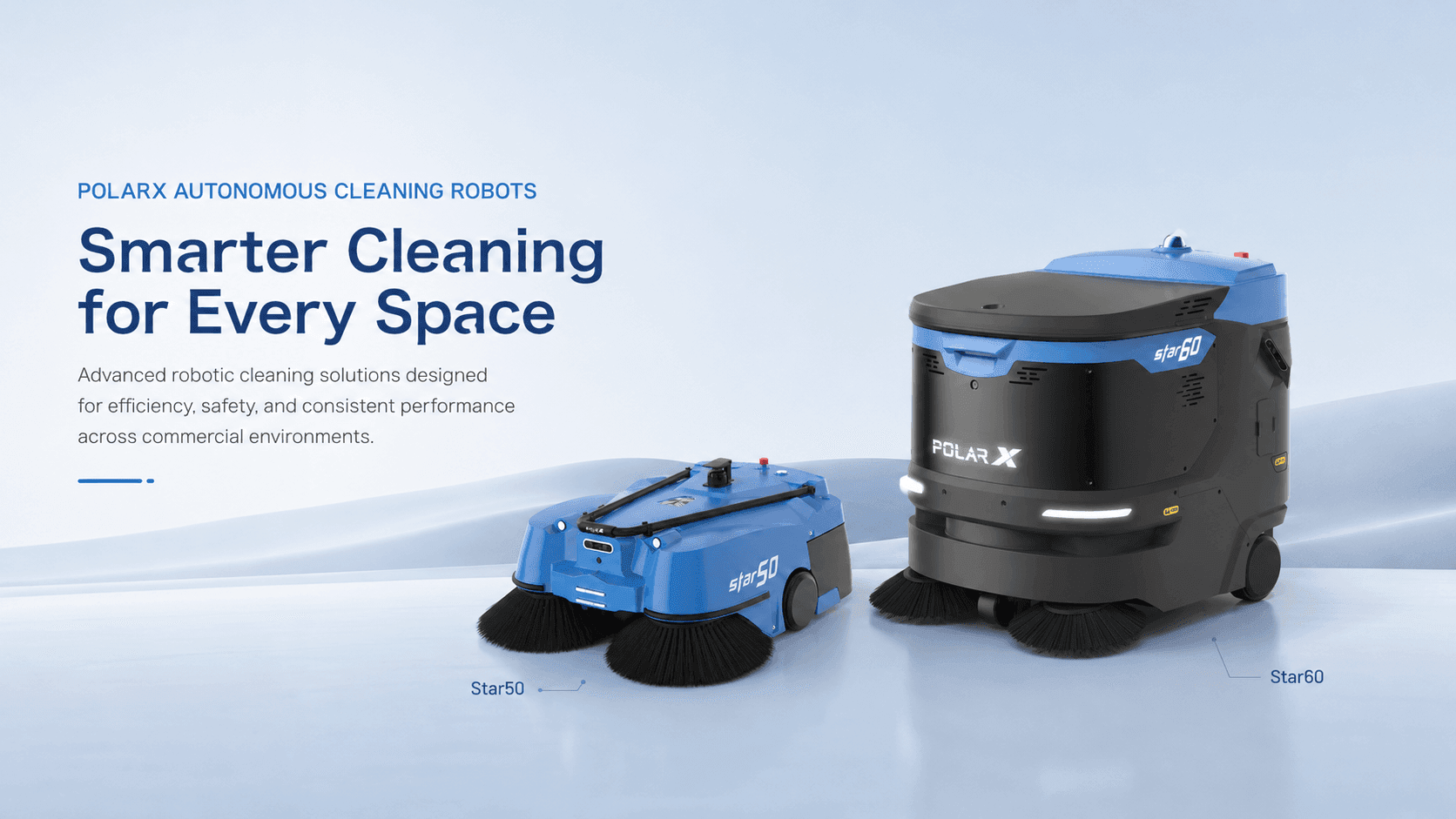
Autonomous sweepers collect dust, grit and packaging debris in warehouses, factories and logistics sites. PolarX Star50 is in this category.
Commercial robot vacuums focus mainly on carpet in offices, hotels and conference areas. See commercial robot vacuums.
Waterless floor care robots handle the high-frequency daily layer of cleaning: dust, light debris, appearance and dryness. One robot can maintain stone, tile, PVC, timber and commercial low-pile carpet on the same route. PolarX Star60 is in this category.
PolarX focuses on waterless commercial floor care with Star60 and industrial sweeping with Star50, so facilities can separate daily dry maintenance from targeted wet cleaning.
PolarX Robotics is an Australian commercial cleaning robot company based in Melbourne, founded by people from the commercial cleaning industry. Compare robotic floor scrubbers with waterless cleaning robots.
Most buyers have never deployed one, and "autonomous" is doing a lot of unexplained work in the marketing. Here's what actually happens.
On the first visit the robot is driven around your site once to build a floor plan. You then mark out zones — clean this, avoid that, don't cross here. This takes a site visit, not weeks.
Once the map exists, the robot positions itself against permanent features like walls and columns, so it knows where it is without needing markers on the floor. Sensors handle whatever isn't on the map like a trolley left in an aisle, a person walking across the route can manage by slowing, going around, or stopping. PolarX Star60, for example, uses 2D LiDAR and four depth cameras to locate itself and detect people and obstacles.
You set routes to run at chosen times. The robot leaves its dock, runs the route, returns and charges. On a large site it can recharge partway and pick up where it stopped.
After each run you get a record of the area covered and any part of the route it couldn't complete. This matters more than most buyers expect — it turns "the floor was cleaned" from an assumption into something you can show a client or an auditor.
Layouts that change weekly need re-mapping. Congested and heavily furnished areas cut real coverage rates well below the headline figure. Multi-level sites need a plan for moving the robot between floors. None of these rule a site out, but they should be checked before purchase, not after.
A good buying process reviews the facility workflow before comparing headline features.
Wet-cleaning burden in numbers
A conventional walk-behind scrubber uses roughly 0.08 L of clean water per m². A 40 L tank covers about 500 m². For a 10,000 m² facility, that means around 800 L of clean water, and 800 L of wastewater, for every full wet clean. Most facilities do not need that every day.
Reduce wet scrubbing from daily to weekly, with waterless robotic care on the other six days, and the modelled annual impact looks like this:
Each avoided wet clean also removes the work that surrounds it: filling the tank, moving the machine to a water point, draining and rinsing the dirty-water tank, cleaning filters and squeegees, and the wear on pumps, hoses and water systems.
| Cost item | Basis | Modelled annual saving |
|---|---|---|
| Water and sewage disposal | 250 kL at AUD $5 to $8 per kL | AUD $1,250 to $2,000 |
| Wet-cleaning handling labour | 313 hours at AUD $35 to $45 per hour | AUD $10,955 to $14,085 |
| Wet-system maintenance | 313 events at AUD $3 to $6 per event | AUD $939 to $1,878 |
| Modelled annual operating saving | approx. AUD $13,100 to $18,000 | |
Labour is the largest share. This is not because the robot replaces a cleaner. It is because 313 hours of tank handling and machine preparation move to higher-value work such as edges, washrooms and spills.
Modelled 10,000 m² commercial facility using Australian water tariffs and fully loaded cleaning labour rates. Water and sewage disposal charges vary by utility and trade-waste category. Labour cost varies by award classification and shift timing. Figures are illustrative only and are not a guaranteed outcome.
Most commercial cleaning robot comparisons are written for the US or Europe. Australian buyers have a few extra questions worth settling before the demo.
Star60, the commercial default
Built for occupied indoor spaces with a mix of hard floor and commercial low-pile carpet: PVC, tile, stone, marble and timber, all in the same pass. Up to 850 m²/h in suitable open environments. Star60 is the starting point for most Australian shopping centres, aged care facilities, hotels and offices.
Facility paths
Use these entry points to move from the general commercial cleaning robot category into a specific buying question.
Next pages
These pages help customers move from the main commercial cleaning robot guide into product selection, proof points, downloads or contact.
A commercial cleaning robot is an autonomous cleaning machine designed for business and facility environments, not home use. It maps the site, follows scheduled routes, avoids obstacles and returns to charge. The main types are robotic floor scrubbers, autonomous sweepers, commercial robot vacuums and waterless floor care robots.
The main types are robotic floor scrubbers for wet cleaning of sealed hard floors, autonomous sweepers for dust and debris on industrial floors, commercial robot vacuums mainly for carpet, and waterless floor care robots for daily care across hard floors and carpet. PolarX makes an autonomous sweeper (Star50) and a waterless floor care robot (Star60).
Commercial cleaning robots use LiDAR, depth cameras and other sensors to detect people and obstacles and slow down, go around or stop. Waterless robots also avoid leaving wet floors behind, which can help reduce slip risk in occupied spaces.
Many robots rely on cloud connectivity for maps and reporting. PolarX robots support offline deployment and operation for sites with restricted networks or strict IT and privacy requirements.
Usually yes. Some buyers search for commercial clean robot, but the standard term is commercial cleaning robot. PolarX uses commercial cleaning robot because it better describes the category.
Warehouses usually need industrial sweeping, dust control and dry debris collection. PolarX Star50 is the main fit for warehouse and logistics cleaning missions.
Commercial cleaning robot price depends on product type, capability, support model, deployment requirements and utilisation. Buyers should compare total operating value, not only purchase price.
Some commercial cleaning robots can support suitable commercial carpets. PolarX Star60 is positioned for waterless daily maintenance across suitable commercial carpets and hard floors, subject to site review.
Retail, healthcare, hotels, offices and public spaces usually need dry daily floor care and lower wet-floor disruption. PolarX Star60 is the main fit for these occupied commercial environments.
Choose Star50 for warehouse, logistics and industrial sweeping. Choose Star60 for waterless daily floor care across suitable occupied commercial floors and carpets.
No. Commercial cleaning robots are best used to reduce repetitive floor-care work so staff can focus on details, edges, supervision, washrooms, spills and higher-value cleaning tasks.
Tell PolarX about your floor surfaces, facility type, cleaning frequency and current workflow so we can help review the right starting point.
